

Love is patient; love is kind; love is not envious or boastful or arrogant or rude. It does not insist on its own way; it is not irritable or resentful; it does not rejoice in wrongdoing.(1Cor 13:4-7)


Homily
Divine Humiliation - Sunday, August 16, 2026
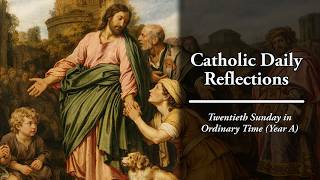
“It is not right to take the food of the children and throw it to the dogs.” She said, “Please, Lord, for even the dogs eat the scraps that fall from the table of their masters.” Then Jesus said to her in reply, “O woman, great is your faith! Let it be done for you as you wish.” Matthew 15:26–28
Imagine the Son of God referring to you as a dog. For most people, that would be deeply offensive. So why would Jesus do such a thing? He did so, in part, to draw forth from this woman an act of profound humility and faith. Through this moment of divine humiliation, Jesus invited her to rise to a heroic response, prompting Him to exclaim, “O woman, great is your faith!” He desires to do the same with each one of us.
When Jesus first encountered this woman, He saw into her soul and perceived the depth of her faith. As God, He knew everything about her—her suffering, her love for her daughter, her perseverance. He also knew He would heal the girl, yet He did not do so immediately. Instead, He engaged in what theology refers to as divine pedagogy—a method of instruction by which God teaches slowly, carefully, and with purpose. In this case, Jesus used the moment to teach His disciples, and us, a profound lesson about humility and unwavering faith. He tested her, and she passed the test marvelously.
The location of this encounter is also significant. It took place in the region of Tyre and Sidon, in modern-day Lebanon—a Gentile territory known for its Greek-speaking population and pagan customs. The woman is specifically identified as a Canaanite, evoking the memory of Israel’s ancient enemies. And yet, it is precisely this outsider—this woman of seemingly little spiritual privilege—who becomes a model of the faith the chosen people were meant to embody.
She first approaches Jesus, crying out, “Have pity on me, Lord, Son of David! My daughter is tormented by a demon.” By calling Him, “Son of David,” she reveals her belief in His messianic identity. But what does Jesus do? Nothing. He appears to ignore her—not because He is displeased or uncaring, but because He is testing her faith, knowing full well she will persevere and shine.
God often allows similar experiences in the lives of the faithful. It’s easy to assume that if we follow Christ, we will be shielded from difficulty. On the contrary, one of the most powerful ways God forms His saints is by allowing them to undergo trials. These trials, far from being signs of abandonment, are invitations to heroic virtue. They are divine tests. And God never permits more than we can endure by His grace.
Reflect today on the ways God may be inviting you to a deeper faith through silence, delay, or trial. Could He be calling you, like this woman, to heroic humility and steadfast trust? Embrace those moments of divine testing, for they are often the very means by which His greatest works of grace are accomplished—in you and through you.
Divine Teacher and Guide, You teach us through Your Word, Your actions, and even through Your silence. When You are silent in the midst of trials and tribulations, grant me the grace to persevere in faith, trusting that You will never abandon me. Help me to understand that every trial You permit is an invitation to deeper trust, so that Your grace and glory may be revealed in me, and through me, shine forth to others. Jesus, I trust in You.
Source: mycatholic.life
Share: