

Search me, O God, and know my heart! Try me and know my thoughts! And see if there be any grievous way in me, and lead me in the way everlasting! (Psalm 139:23-24)


Provincial Message
My Son! Embrace Wounds, Bring Healing and Build Communion
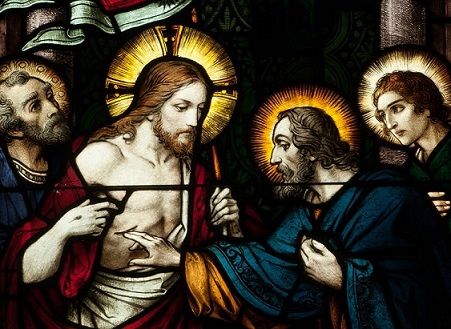
Warm greetings in the Risen Lord. Let us continue to gaze at the Risen Lord who carries the mark of wounds suffered on the Cross and learn from Him that wounds can become sources and channels of healing, as he accompanies his fragile and wounded apostles. As we prayerfully journey with Risen Christ during this Easter season and find strength in His wounds for our own wounds, we are invited to contemplate more deeply on the mystery of our own wounds: those we receive, those we cause, and those that silently shape our lives and relationships. In religious communities, wounds exist in visible and hidden forms: some arise from words spoken without care, others arise from actions that are misunderstood and still others come from personal vulnerabilities that become sources of suffering when they are exposed or judged. Many who carry such wounds desire to move forward and begin anew. Yet, they often experience resistance from others, who continue to define them by their past. In some of the most painful situations, individuals feel unwelcomed within our communities. They experience exclusion instead of belonging, silence instead of dialogue, indifference instead of care, distance instead of fraternity, rejection instead of acceptance, loneliness instead of communion, and judgment instead of understanding. In the light of Easter, may I invite all of us to reflect on these realities in our communities with honesty and hope. Let us allow the Risen Lord to walk into our communities and our lives to guide us toward healing and renewal.
Jesus and His Wounds
Let us continue to reflect on Jesus Himself, who chose not to avoid wounds but to accept them fully. His suffering was not limited to physical pain. It reached the deepest dimensions of human relationships. He experienced betrayal from Judas. He faced denial from Peter. He endured abandonment by the disciples who had walked closely with Him. He was rejected in public by religious authorities. He was condemned in public by the crowd. Yet in the face of these wounds, Jesus did not respond with anger or rejection. From the Cross, He revealed a different way of being. He prayed for forgiveness for those who crucified Him. He entrusted His life entirely to His Heavenly Father. His response should transform our understanding of wounds and weaknesses. It shows that wounds need not lead to bitterness. They can become a path to healing and redemption.
Risen Christ in Search of the Wounded
Jesus, after His Resurrection, takes the initiative to seek out those who are wounded and those who have wounded Him. He does not wait for them to return on their own, but goes in search of them with patience and love. Peter, after denying Jesus, withdraws into shame and confusion, yet the Risen Lord meets him by the sea and restores him through a gentle dialogue of love. Judas Iscariot represents a more tragic and complex reality. His betrayal wounds the heart of Jesus deeply, and Judas’ despair prevents him from remaining within the circle of mercy. Yet, Pope Francis invited the Church to contemplate a striking medieval sculpture found on top of a column at the Basilica of Saint Mary Magdalene in Vézelay, France, built between 1120-1150. In the sculpture on the column, Risen Christ is shown carrying Judas on His shoulders like the Good Shepherd carrying the lost sheep. The face of Judas is turned toward Christ, half-smiling, while Christ carries him with tenderness on his shoulders, with a half-smile. When you put together the two half-smiling faces of Jesus and Judas, you would get a perfect joyful face. The Redeemer and the betrayer who is redeemed merge to form a single joyful face. The holy and the sinner delivered come together, that is the greatness of the mercy of God and complexity of redemption. There is no sin greater than the mercy of God. God’s love, mercy and redemption gets completed when the sinner is liberated from the fallen state. Judas is a lost coin, so Jesus like the woman in the parable has to take all the responsibility of finding the lost coin. The Lost coin cannot do anything on its own when compared to the lost Son, who can come back to the Father or the lost Sheep fallen into a well or pit can at least bleat. The Pope used the sculpture of Jesus carrying Judas on his shoulders, not to deny the seriousness of betrayal, but to highlight the unfathomable depth of divine mercy that continues to seek the sinner even in the darkest moment. It is an invitation to hope in a mercy that surpasses human judgment and refuses to abandon the worst of sinners. In this light, we are led to recognize that no wound, whether inflicted or received, places a person beyond the reach of Christ, who searches and restores not by force but by love.
The experience of the disciples themselves reflects the reality of wounds within a religious community. During their time with Jesus, they struggled with rivalry and misunderstanding. They sought positions of importance. They failed to understand the mission of their Master. After His death, fear led them to withdraw and scatter. Yet the Resurrection and the gift of the Holy Spirit at Pentecost brought transformation. They learned to forgive one another. They learned to trust again. They grew into unity despite their past failures. Their journey shows that wounds within a community do not have the final word. When individuals open themselves to grace, a fractured group can become a united witness to the Gospel.
How did the Biblical Patriarchs and Their Sons Handle Personal Wounds?
The experience of wounding and healing is often woven into the fabric of human relationships, where misunderstanding, betrayal, or neglect can fracture communion. Even among the patriarchs, we see this pattern unfold: Isaac endured conflict and exclusion at the hands of Abimelech, facing suspicion and displacement; yet when they met again, he chose peace and entered into a covenant that restored their relationship (Gen. 26,26-31). Jacob, too, lived through years of tension and mutual deception with Laban, marked by rivalry and mistrust; yet in the end, they chose to part through an agreement that prevented further harm and opened a path toward peace (Gen. 31,43-54). Likewise, Isaac and Ishmael, long separated by family division and pain, came together at Abraham’s burial, setting aside their differences in a moment of shared dignity and reconciliation (Gen. 25,9). These examples show that wounds in human relationships can be transformed through deliberate choices for peace and reconciliation. In this way, communion is patiently rebuilt through forgiveness, trust, and the willingness to move beyond past hurt.
How did the Early Christian Community Address the Wounds of New Believers?
In the early Church, wounds became especially visible during times of persecution. Some believers, out of fear of suffering or death, denied their faith. This led to deep pain within the Christian community. A serious division arose over how to respond to those who had fallen. One group insisted that those who had betrayed their faith should not be re-admitted into the Church. They believed that such a failure had permanently broken communion. They argued that allowing them back would weaken the witness and purity of the Christian community. Another group, however, recognized the human weakness behind such actions and called for a path of repentance and reconciliation. This disagreement created tension and fragmentation within the Church. It was not merely a disciplinary issue but a question about the very nature of the Church. The Fathers of the Church reflected deeply on this crisis. Many of them chose the path of mercy without compromising the seriousness of the failure. They insisted on sincere repentance and appropriate penance. At the same time, they affirmed that no sin was beyond the reach of God’s forgiveness. They worked to heal divisions and restore unity. By welcoming the fallen back into communion, they revealed that the Church is not a society of the perfect but a community sustained by grace, forgiveness, and the constant possibility of new beginnings.
How did the Monastic Tradition Address the Wounds of Individuals and Community?
Monastic and religious life consistently treated conflict not as a disruption to community life but as something to be actively healed through structured practices of humility, correction, and reconciliation. In the Western monastic tradition shaped by the Rule of Saint Benedict, conflict is assumed to arise in daily life, and the Rule insists that it must be resolved quickly. Benedict explicitly warns against allowing anger to persist beyond a day, echoing Ephesians 4,26. The underlying principle is that unresolved emotion leads to communal fracture, and so reconciliation is made immediate rather than postponed.
This principle becomes concrete in Benedict’s disciplinary system, especially in Chapter 44 of the Rule, where a monk who has offended another is required to publicly acknowledge the fault and ask forgiveness before the community. The act is not only symbolic but procedural. The monk physically humbles himself, the community responds with forgiveness, and reintegration follows. The structure ensures that wounds are not hidden in private resentment but openly acknowledged and ritually closed within the community.
A similar dynamic appears in the Desert tradition recorded in the Sayings of the Desert Fathers. In one well-known episode, attributed to Abba Moses the Black, monks gathered to judge a brother who had fallen into sin. Moses arrived carrying a torn sack of sand that spilled behind him. When questioned, he said that his sins ran out behind him unseen, yet he was preparing to judge another. The assembled monks, confronted with this embodied humility, abandoned judgment and instead extended mercy. The conflict that could have become exclusion is transformed into collective repentance.
In the Cenobitic monasticism of St. Pachomius, as described in the Life of Pachomius, conflicts were managed primarily through institutional containment. Monks lived under a shared rule, and disputes were not permitted to circulate informally among the community members or spread them to others outside the community. Instead, the conflicts were brought directly to the appointed superiors, who mediated the resolution. Importantly, reconciliation was required before full return to communal worship. This ensured that personal grievances did not evolve into factions and that unity was preserved through authority-guided correction. When authority intervened at different levels to mend the broken relationships or resolve conflicts among the brothers, no member of the congregation took offence at him or attacked him clandestinely or interpreted the action of the superior with motives of malevolence.
In the Franciscan tradition, Saint Francis of Assisi emphasized interior humility as the primary remedy for interpersonal conflict. In the Admonitions of Saint Francis, he teaches that a friar should not be troubled when corrected, even unjustly, but should receive correction as a grace that purifies pride. In narrative traditions such as the Little Flowers of St. Francis, conflicts among friars are repeatedly defused through Francis’ refusal to retaliate or assign blame, instead redirecting attention toward humility, patience, and self-examination. The emphasis is less on determining fault and more on preserving charity within the fraternity.
A more theological model appears in Saint Dorotheus of Gaza, who in his discourses uses the image of a circle with God at the center. As preserved in the discourses and sayings of Dorotheus of Gaza, he explains that as individuals move closer to God, they also move closer to one another. Conflict, therefore, is interpreted as a symptom of spiritual distance rather than merely interpersonal failure, and reconciliation is achieved by reorienting oneself toward the divine center.
How did St. John Bosco Address the Wounds?
A later but equally influential example appears in the educational and pastoral approach of our Father and founder St. John Bosco within our tradition. In his own writings, especially the Memoirs of the Oratory, he explains that conflicts among the young in his Oratory were addressed not primarily through punishment but through what he called the preventive system. This method required the constant presence of the educator among the young, allowing early signs of disorder to be corrected through conversation, trust, and moral persuasion rather than coercion. He observed that punishments often hardened resentment, whereas timely and personal intervention prevented from forming deeper wounds. For this reason, he insisted that the educator must be at once a Father, Teacher, and Friend, so that correction arises within a relationship of loving care and not as an external imposition. This closeness created an atmosphere in which discipline was accepted and interiorized, making reconciliation both natural and lasting.
How does the Salesian Tradition Address the Wounds?
Within the Salesian tradition that developed from his spirit, this approach became a model for community life and fraternal relationships. St. John Bosco himself faced misunderstanding and opposition, yet he refused to allow such experiences to turn into resentment, instead transformed them into compassion in his dealings with others. He corrected his Salesians with patience and kindness, always avoiding humiliation, and fostered environments where individuals could rediscover dignity and purpose. This vision is reflected in the Salesian Constitutions, which call for communities rooted in fraternal charity, where each member is respected, supported, and never made to feel excluded. The Constitutions emphasize the need for ongoing conversion, attentiveness in speech and action, and the practice of forgiveness and fraternal correction. In continuity with the broader teaching of the Church, our spiritual tradition highlights mercy and accompaniment, urging communities to move beyond judgment and to create spaces where even those who carry wounds can experience acceptance, belonging, and healing.
Across the traditions we have seen so far, from Benedict’s structured reconciliation to Moses’ humility, Pachomius’ institutional discipline, Francis’ radical gentleness, Dorotheus’ theological framing, and St. John Bosco’s preventive relational method, the pattern remains consistent. Conflict and wounds are not treated as failure of the system but as material to be transformed. Wounds that appear between individuals are addressed through immediacy, humility, authority or relationship, always with the aim of restoring communion rather than assigning the blame to others.
Conclusion
To close the reflection, we began on embracing wounds, bringing healing and building communion, the Risen Lord still bears His wounds and they are signs of glory. This is our hope. Our wounds can be transformed when we place them in His hands and seek the help of our brother Salesians in the community. Let us not allow our wounds to divide us. Let them become pathways to communion and mission. May our communities reflect and experience the power of the Resurrection. May every wound be met with compassion. May every person be welcomed with dignity. May every life be opened to new beginnings.