

“Be still, and know that I am God! I am exalted among the nations, I am exalted in the earth.” (Psalm 46:10)


Provincial Message
Renewing Our Salesian Vocation and Oratorian Heart through Prayer, Annual Retreat and Paschal Joy
When I look at our world today, I feel a deep unrest, and I am sure you feel it too. Wars in places like Iran, Israel, Ukraine, and Russia continue to bring pain to countless people. Families are broken, and children are growing up in fear. Even closer to us, many families struggle with financial stress and broken trust. Our young people are often confused and easily drawn to voices that lead them away from God. All these touch us deeply. At the same time, our own ministries and responsibilities can leave us tired and weary. We begin to feel pulled in many directions. In such moments, there is also the quiet temptation to focus on ourselves, on our success or recognition, and slowly we lose sight of why we chose the Salesian congregation or religious life or priestly life.
It is exactly in this situation that the Lord calls us back to Himself. He does not first ask us to do more, but to return to our hearts. If our hearts are not rooted in God, our work will soon feel empty and our strength will fade. That is why silence is not a luxury. It is necessary, because it is in silence that God speaks, heals, and strengthens us. In the same way, discipline is not a burden but a help, guiding us toward a life that is free and faithful. When we give time to prayer and reflection, we begin to see clearly again. We learn to serve without losing ourselves and to love with patience and strength. The world does need our presence, but even more, it needs consecrated men whose hearts are firmly rooted in God. Only from such hearts can true compassion, courage, and faithful service grow.
Deepening Our Relationship with the Lord
Intimacy with God is never automatic; it must be pursued, practiced daily, and protected. The saints, our great companions in faith, show us the way. St. Francis de Sales invites us to speak to God as to a friend and St. John Bosco teaches us to carry God’s presence into every action we undertake. Let us dedicate ourselves to meditating on Scripture, sitting before the Blessed Sacrament, receiving the sacraments faithfully, practicing mortification, seeking spiritual direction, cultivating awareness of God’s presence in every moment, engaging fully in community life, and attending guided retreats. Let us remember that each practice or a habit is a ladder lifting the soul toward Christ, and when our hearts are shaped by these habits, we can face the chaos of the world with courage, clarity, and joy, becoming beacons of hope for the young and the vulnerable we serve.
Annual Retreats
Spiritual exercises, or the annual retreat, are our sanctuary, a sacred space where God gently shapes our hearts. Following the example of St. John Bosco, who cherished prayer even in the midst of tireless service, we enter this time with humility, inner silence, and focus. Here, we reflect on the Word of God, discern His will for our lives, and renew our commitment to the Salesian mission. Guided by the Constitutions and the wisdom of the saints, we embrace stillness so that when we return to our communities, we do not simply resume our work but return changed. The retreat is not an escape from activity. It is a time when our hearts are strengthened, our mission becomes clearer, and our witness grows brighter. We are invited to come with honesty, without pretending to be perfect, and with a willingness to be led. We bring our real life into prayer, our work with the young, our struggles in community, and even our tiredness, trusting that God is already at work in these moments. We listen more than we speak, remain faithful to the simple rhythm of the retreat, and stay open to God’s quiet guidance through Scripture and silence.
After the retreat, the goal is not to hold on to a passing feeling but to live out what we have received in simple and steady ways. We shape our day with regular moments of prayer, take brief pauses before our work, and give our attention to the young with greater care. The retreat helps us grow in patience, work better with others, and notice the hidden needs of those around us. It teaches us to respond thoughtfully instead of reacting quickly, and to value faithfulness in our mission more than visible results. In this way, the spirit of the retreat becomes part of our daily life. We begin to live with a quieter heart, a clearer sense of purpose, and a deeper trust in God who continues to guide us in our Salesian vocation.
Preparation for Holy Week
For us Salesians, Holy Week is a path of ascent that begins with sincere conversion and leads to a renewed pastoral charity shaped by the Paschal Mystery. In the spirit of St. John Bosco, preparation involves concrete and demanding practices that he encouraged in his boys and followers: a good and sincere confession before the Paschal Triduum, a devout and conscious reception of Holy Communion, and attentive participation in the sacred liturgies. He urged them to avoid distractions and to live these days with gratitude and seriousness.
From this foundation, a Salesian is invited to move inwardly. As Augustine of Hippo teaches, we are called not just to remember Christ, but to be transformed by Him, allowing His humility to reveal our need for grace. Then, as John Chrysostom explains, this inner conversion should show itself outwardly in acts of charity, reconciliation, and care for the poor. The journey deepens in contemplative union, where, like Francis of Assisi, we linger with love before the suffering Christ, and, taking inspiration from Teresa of Ávila, we allow prayer to shape our life into real conformity with Him. The Salesian does not remain at the level of external ministry alone, but gradually rises from repentance to participation, from compassion to transformation, so that by the time of the Resurrection, the Salesian priest stands not only as a celebrant of the mystery, but as a witness whose life quietly proclaims Christ’s victory among the young and the poor.
Celebration of Priesthood
Saint Joseph Cafasso’s own writings and the way others have articulated his spirituality offer a profound and concrete picture of priesthood that can deeply enrich how we celebrate it today, especially in moments like Maundy Thursday. In his classic work The Priest: The Man of God, a collection of his conferences and reflections, Don Cafasso unfolds priesthood not as a role to be performed but as an identity to be transformed through virtue, prayer, and sacramental fidelity. He reminds priests that the dignity of their calling is higher than all others and that they must strive with their whole being to become what they celebrate, above all in the Eucharist and in confession.
What emerges repeatedly in both his written teaching and the testimony of those who knew him is a spirituality of gradual interior ascent: the priest must first become a “man of God” inwardly, rooted in deep prayer, a delicate conscience, and the habit of virtue, so that outward ministry flows from a heart conformed to Christ. His emphasis on interior life and the ministry of mercy, especially in the sacrament of reconciliation, shows that true celebration of priesthood begins with the priest’s own conversion: “a priest belongs on the altar and in the confessional,” producing transformation by the Holy Spirit and divine mercy.
Don Cafasso also models pastoral holiness lived in the midst of human struggle. He was known as the “Priest of the Gallows” because he accompanied condemned prisoners to their execution with compassion and fidelity, bringing God’s mercy to the margins of society. This stark witness reminds priests today that celebration of their vocation must grapple honestly with weakness, fatigue, and cultural indifference, while anchoring them in prayer and Eucharistic life. By drawing from his writings and example, the celebration of priesthood becomes not merely ceremonial, but an invitation to rise in interior virtue, sacramental faithfulness, pastoral courage, and merciful service, reflecting Christ who came not to be served but to serve.
The Event of Resurrection Then and Now
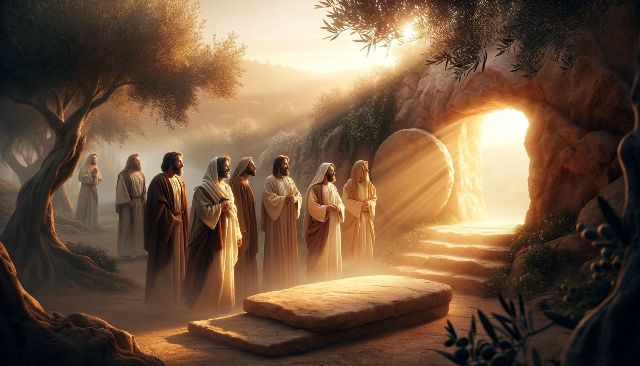
Easter morning begins with something strikingly simple: a tomb that could no longer hold its secret. The stone rolled away is not only a sign of Christ’s victory but a symbol of how God breaks open what humans believe to be sealed forever failure, grief, injustice, and even death itself. In a world that often feels locked by fear, violence, ecological anxiety, and the silent loneliness of modern life, Easter interrupts the narrative of inevitability. It tells us that history is not trapped in decline; God can still begin something radically new. The Resurrection therefore invites believers to look at today’s world with a daring imagination: beneath the noise of crises and uncertainties, the quiet energy of divine life is already stirring, preparing unexpected resurrections in hearts, communities, and societies.
This Easter vision also reshapes the way we inhabit the present moment. The first witnesses of the Resurrection encountered the risen Christ not in spectacular temples but in ordinary paths, walking on a road, sharing bread, calling someone by name in a garden. In the same way, Easter today unfolds in subtle yet powerful ways: when hope returns to someone who felt defeated, when reconciliation heals a fractured relationship, when young people rediscover purpose in a confused world, or when communities choose compassion over indifference. Each of these moments is like a small dawn within the larger dawn of Easter. The Resurrection therefore becomes a living horizon for our time, inviting believers to recognize that God’s future is already pressing gently into the present, turning ordinary days into spaces where new life quietly begins again.
Salesian spirituality is a spirituality of the Resurrection
From the very pulse of Salesian consecrated life, the Resurrection shapes identity and mission. The Constitutions proclaim that “the religious profession of the evangelical counsels makes the Salesian a sign of the power of the resurrection” (Art. 63), grounding the vows not in asceticism alone but in the visible triumph of risen life. This victory over self-centered attachments is echoed in the call to live Sunday as the “pre-eminent feast of the Christian people” founded on “the mystery of Christ’s resurrection… and is therefore to be observed with joy” (Art. 89), weaving Easter’s light into the weekly rhythm of community life. In the very way community is lived, too, the Constitutions affirm that Salesians form a body “gathered by the Father” and “founded on the presence of the Risen Christ,” a presence that shapes family spirit, mutual support, and the joy of fraternity. This same paschal presence undergirds the orientation toward young people whose lives often feel broken: in the Salesian encounter with youth, the risen Christ is present “awakening in them hope and the dedication and joy to which it gives rise” (Art. 63). In these constitutive moments—vows, Sunday, community, and youth ministry—the risen Lord is not a memory but the animating principle of Salesian life, where the victory of life over death becomes the daily grammar of mission.
This paschal core also shapes the way Salesians understand suffering, hope, work, and ultimate destiny. The Constitutions reflect that “in the Cross the Son reveals his obedience to the Father and his total gift of self… From the Cross comes the life of the risen Christ, life according to the Spirit with its fruits of grace and salvation” (Art. 26), anchoring Salesian consecrated life in the very mystery from which resurrection life flows. The risen Christ remains the wellspring of hope even in loss, for “faith in the risen Christ sustains our hope and keeps alive our communion with our brothers who rest in Christ’s peace” (Art. 94), giving meaning to memory, continuity, and love beyond death. Work and daily life are thus not simply tasks but places where the risen Lord’s life transforms the ordinary into the extraordinary, where patience, joy, and fidelity are signs that Christ’s resurrection power is alive among his people. Together, these texts reveal that Salesian spirituality is not merely shaped by the Resurrection, it is a resurrection spirituality, a living, dynamic faith that meets young people in the reality of their lives and invites the entire community to participate in the new life ushered in by Easter.
Preparing for Our Summer Pastoral Mission
Every Salesian pastoral initiative during the summer is more than a set of well-organized activities: it is a privileged moment where vocation, community life, and mission converge in a concrete way. To approach summer camps, youth camps, and Vacation Bible School meaningfully, it is important to recognize that their fruitfulness depends not simply on external success, but on the depth of preparation at multiple levels: the community as a whole, the confreres within it, those entrusted with leadership, and the shared effort that binds them together. This fourfold lens allows us to see preparation not as a preliminary task, but as an integral part of the mission itself, shaping both the spirit in which these apostolates are carried out and the impact they leave on the young. Rooted in the vision of St. John Bosco, such an approach helps ensure that every initiative becomes a lived expression of accompaniment, formation, and joyful evangelization.
For summer camps, the Salesian community prepares itself by shaping the camp as a balanced experience of play, prayer, and personal growth: first, by discerning the deeper purpose behind activities so that recreation becomes formation; second, by creating an environment of family spirit that reflects the preventive system of John Bosco; and third, by ensuring structures of safety, inclusivity, and joyful discipline. The confreres in the community prepare by, first, studying the profile of the young participants and anticipating their needs; second, sharing responsibilities in a way that highlights each one’s gifts (animation, catechesis, organization); and third, committing to a visible and approachable presence throughout the camp. Those directly in charge of summer camps prepare individually by, first, cultivating an attentive leadership that notices both group dynamics and individual struggles; second, designing programs that integrate moments of silence, reflection, and celebration; and third, developing the flexibility to adapt when plans meet reality. Together, they prepare by, first, rehearsing activities and clarifying roles; second, building a unified style of interaction with the young; and third, setting up daily evaluation moments to remain responsive.
For youth camps, the focus deepens: the community prepares by, first, centering the experience on vocational discernment and meaning-making; second, fostering spaces for dialogue and questioning; and third, integrating witness talks and faith-sharing. Confreres prepare for youth camps by, first, accompanying rather than instructing; second, creating trust where young people can speak honestly; and third, modeling authenticity in their own life stories. Leaders prepare individually by, first, being interiorly grounded to guide others; second, preparing themes that connect faith with real-life struggles; and third, learning to facilitate group processes. Together, they prepare by, first, structuring moments of group reflection; second, ensuring continuity from one session to another; and third, supporting one another in guiding deeper conversations, echoing the call of Pope Francis to walk with the young in discernment.
For Vacation Bible School (VBS), the preparation becomes more explicitly catechetical and imaginative. The community prepares by, first, ensuring that Scripture is presented not as abstract teaching but as a living encounter; second, creating a child-friendly environment marked by joy, creativity, and clarity; and third, aligning the entire program with a simple, coherent biblical theme. Confreres prepare by, first, simplifying language without diluting meaning; second, engaging actively with children through storytelling, songs, and gestures; and third, maintaining patience and attentiveness to each child’s pace of learning. Those in charge prepare individually by, first, internalizing the biblical message so as to communicate it with conviction; second, crafting sessions that combine teaching with activity; and third, being attentive to discipline in a way that is firm yet kind. Together, they prepare by, first, coordinating teaching, music, and activities into a unified flow; second, supporting one another in maintaining energy and enthusiasm; and third, evaluating daily how effectively the message is being received. Across all three settings, the four levels of preparation converge in a shared pastoral spirit: a community that inspires, confreres who collaborate, leaders who are formed interiorly, and a team that acts in unity. As Thomas Groome reminds us, faith formation becomes effective when it engages the whole person in experience, reflection, and action, ensuring that every camp or VBS moment becomes not just an event, but a lasting encounter with Christ.
Remembering the Canonization of Don Bosco
When the Church raised John Bosco to the altars on Easter Sunday, April 1, 1934, she did more than canonize a holy man; she revealed a way of being that the world still urgently needs. He was declared a saint on the day the Risen Christ first appeared to those who mourned and despaired—this is no coincidence. Don Bosco’s holiness was forged in the tension between hope and struggle, joy and weariness, promise and abandonment. He carried Easter in his bones, not as sentiment, but as a conviction that no young heart is ever too lost, too bruised, or too silent to be touched by God’s mercy.
Don Bosco’s life reflects the paschal pattern: he welcomed many who were cast aside, gathered them around Christ’s banquet, and guided them into a life of dignity and purpose. His sanctity was not shaped in quiet cloisters but in the sweat and laughter of the oratory, in the quiet perseverance of prayer, and in the merciful courage to accompany young people through their worst fears and highest hopes. He lived the Gospel as Christ lived it: with open arms, a watchful heart, and a relentless creative love.
What does this mean for us today? To celebrate his canonization is first to recognize the God who worked through him, a God who does not abandon, does not forget, and does not count holiness in achievements but in love lived faithfully. Don Bosco invites us to rise again each time we fall, to choose patience over judgment, and to turn every encounter into a chance for Christ’s presence to be visible. His canonization, on Easter Day of all days, tells us that holiness is not tragic, it is triumphant; it is not isolated, it is communal; it is not passive, it is missionary joy.
In a world that often measures success in power, profit, or popularity, Don Bosco reminds us that true greatness lies in the tender courage to love others into life. His life, now enshrined in the calendar of saints, bears witness to the truth that God’s grace can transform every broken dream into hope, every abandoned child into someone seen and valued, and every trembling heart into a witness of joy. As we celebrate his canonization and prepare for the centenary in 2034, may we not only admire his deeds, but internalize his heart: a heart that beats for the young, that rejoices in mercy, and that teaches us that to love as Christ loves is the highest vocation of all.
Conclusion
Dear confreres, the strength of our mission comes from our union with Christ. When we cultivate silence, prayer, and a disciplined spiritual life, our ministry becomes more fruitful and authentic. Let us renew our Salesian consecration with generosity, so that, like Don Bosco, we may bring hope, faith, and love to the young people entrusted to us. May Mary Help of Christians accompany us in this journey and lead us closer to her Son.