

Love is patient; love is kind; love is not envious or boastful or arrogant or rude. It does not insist on its own way; it is not irritable or resentful; it does not rejoice in wrongdoing.(1Cor 13:4-7)


Provincial Message
To Walk with the Poor, to Become Poor with Christ:
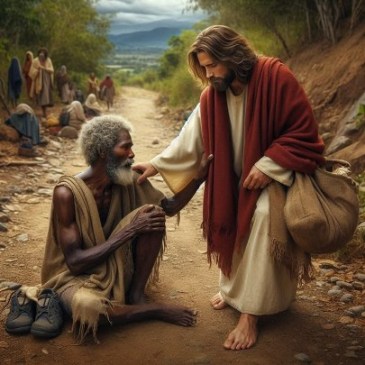
A Salesian Call to Renew Our Preferential Option
The Spirit of the Lord is upon me, because he has anointed me to bring good news to the poor (Lk 4:18).
These words of Jesus, proclaimed in the synagogue of Nazareth, are not merely the opening statement of His public ministry; they reveal the very heart of God’s saving plan. Throughout salvation history, God has shown a particular love for the poor, the marginalized, the widow, the orphan, the stranger, and those who suffer injustice. The Psalms proclaim that “the Lord hears the cry of the poor” (Ps 34:6), while the prophets repeatedly remind Israel that worship without justice is empty. Isaiah declares that the fast pleasing to God is “to share your bread with the hungry, and bring the homeless poor into your house” (Is 58:7). This biblical vision reaches its fulfillment in Jesus Christ, who not only preached to the poor but became poor for our sake, “so that by his poverty you might become rich” (2 Cor 8:9).
The Church has always understood that her mission cannot be separated from Christ’s mission. The Second Vatican Council renewed the Church’s awareness that she must be “the Church of all, and especially the Church of the poor.” (Pope John XXIII). This conviction has found renewed expression in the social teaching of the Church – from Rerum Novarum of Pope Leo XIII to Fratelli Tutti and Laudato Si' of Pope Francis, and more recently in the Magnifica Humanitas of Pope Leo XIV, which reminds us that “there is no authentic evangelization that does not also affect the structures of human society” (Magnifica Humanitas 30). The Declaration on Human Dignity Dignitas Infinita says that “we cannot separate faith from the defense of human dignity, evangelization from the promotion of a dignified life, and spirituality from a commitment to the dignity of every human being.”
For us, as Salesians of Don Bosco, this invitation is not an optional aspect of our vocation. It lies at the very heart of our charism. Don Bosco did not establish schools for the privileged or institutions for social prestige. He gathered abandoned boys from the streets of Turin, welcomed them into the Oratory, educated them with patience and love, and accompanied them towards becoming “good Christians and honest citizens.” Our Constitutions remind us that we are “signs and bearers of the love of God for young people, especially those who are poor” (Const. 2). This commitment is not merely one apostolate among many; it defines our identity and mission.
The Preferential Option for the Poor – Especially the Poorest
The expression “preferential option for the poor” is not a political programme or a sociological theory. It is a theological affirmation rooted in God’s own way of acting throughout history.
The Scriptures consistently reveal God’s loving concern for the vulnerable. The Exodus begins with God’s declaration: “I have witnessed the affliction of my people... I have heard their cry” (Ex 3:7). The prophets condemn those who exploit the poor and remind Israel that true worship is inseparable from justice. Mary’s Magnificat proclaims a God who “has lifted up the lowly” and “filled the hungry with good things” (Lk 1:52–53). Finally, Jesus identifies Himself completely with the least of His brothers and sisters: “Whatever you did for one of the least of these, you did for me” (Mt 25:40).
The Church therefore understands the preferential option for the poor as participation in God’s own preferential love. Pope Francis expresses this beautifully: “From this truth, the Church draws the reasons for her commitment to the weak and those less endowed with power, always insisting on the primacy of the human person and the defense of his or her dignity beyond every circumstance” (Pope Francis, Laudate Deum, 39).
Similarly, Pope Leo XIV teaches that “the preferential option for the poor is a source of extraordinary renewal both for the Church and for society when Christians overcome selfcenteredness and listen to the cry of the poor” (Pope Leo XIV, Dilexi Te, 7).
For Salesians, this option has a distinctive expression. Don Bosco’s preferential love was directed towards poor and abandoned young people. The Salesian Constitutions continually remind us that our educational and pastoral choices must prioritize those who are most disadvantaged and excluded (Const. 2; 6; 11; 24; 26; 27; 33; 41).
Yet the adjective “preferential” also challenges us to discern who among the poor are the poorest. Charity that reaches only those who are easiest to serve risks overlooking those who remain invisible. Don Bosco sought out street children, migrant youth, apprentices, prisoners, and those without education because he recognized that the Gospel always begins from the margins. The same question confronts us today. Are our schools, colleges, parishes, youth centres, social service centres and technical institutes truly reaching the poorest, or have institutional success and financial sustainability gradually distanced us from our original mission?
The preferential option for the poor is therefore not an occasional project. It is the criterion by which every pastoral plan, educational policy, financial decision, and community lifestyle should be evaluated.
Working for the Poor, Walking with the Poor, Becoming Poor
Our Salesian vocation invites us to undertake a journey that unfolds in three progressively deeper stages: working for the poor, walking with the poor, and becoming poor with Christ. These are not three independent approaches but three dimensions of one evangelical vocation.
Working for the Poor: From its very beginning, the Salesian Congregation has expressed its mission through concrete works of charity and education. Don Bosco responded creatively to the social crisis of nineteenth-century Turin by establishing oratories, hostels, workshops, schools, vocational training centres, publishing initiatives, and missionary works. These institutions were never ends in themselves; they were practical expressions of pastoral charity, designed to restore dignity and hope to young people who had been abandoned by society.
Today, our schools, technical institutes, youth centres, hostels, child-care institutions, social services, ministries for Thurumbars, Irulars and Gypsies, and rehabilitation programmes continue this legacy. They remain indispensable expressions of Christ’s compassionate love. Yet the Gospel reminds us that service alone is not enough.
Walking with the Poor: Jesus did not save humanity from a distance. He walked among the poor, shared their meals, entered their homes, listened to their stories, and allowed Himself to be touched by their suffering. The Incarnation itself is God’s decision to walk with humanity.
Don Bosco followed this same path. His boys experienced him not merely as a benefactor but as a father. His Preventive System was built upon loving presence, dialogue, familiarity, and trust. Education, for Don Bosco, was not simply the transmission of knowledge but the sharing of life.
Walking with the poor therefore means cultivating communities that are welcoming, listening, and accessible. It requires us to know the names, stories, dreams, and struggles of the young entrusted to us. It means replacing programmes with relationships and bureaucracy with genuine pastoral presence.
Becoming Poor with Christ: The deepest dimension of our vocation is evangelical poverty. Saint Paul writes: “Though he was rich, yet for your sake he became poor” (2 Cor 8:9). Christ’s poverty was not simply material; it was the total gift of Himself to the Father and to humanity.
The Salesian vow of poverty calls us to share this same freedom. The Constitutions remind us that evangelical poverty means simplicity of life, transparency in administration, moderation in consumption, trust in Divine Providence, and generous availability for mission (Const. 72-79). Poverty is not an end in itself but a missionary witness that allows us to belong completely to the young. Communities that have simple life style proclaim the Gospel more eloquently than many words, while communities attached to comfort and prestige risk obscuring the message they preach.
The journey from working for the poor, to walking with the poor, and finally to becoming poor with Christ is the journey from charity to communion, from service to discipleship, and from external generosity to interior conversion. It is the path walked by Jesus, embodied by Don Bosco, and entrusted to every Salesian today. It is only by following this path that we shall remain faithful to our vocation as signs and bearers of God's love for the young, especially those who are poor.
Who Are the Poor Today?
Poverty is not a static reality. While the fundamental causes of deprivation remain rooted in injustice, exploitation, and exclusion, the forms in which poverty manifests itself continue to evolve. The Industrial Revolution produced the abandoned apprentices whom Don Bosco encountered in the streets of Turin. The twenty-first century has created new forms of exclusion that challenge our pastoral imagination and demand renewed apostolic creativity. For Salesians, this discernment is not merely sociological; it is evangelical. Our Founder did not begin with theories of poverty but with the concrete faces of young people abandoned by society. His educational project emerged from his direct encounter with poor, neglected, and exploited youth. The Preventive System itself was born as a response to their concrete needs and aspirations. Therefore, the first question for every Salesian community remains: Who are the poor whom God is entrusting to us today?
The Materially Poor: The first and most visible face of poverty remains material deprivation. Thousands young people continue to suffer from unemployment, lack of education, poor healthcare, and insecure livelihoods. When national public discourse, especially after CJP, is dominated by NEET, the National Eligibility cum Entrance Test, our Salesian conscience must also be awakened by another NEET – the growing number of young people who are Not in Education, Employment, or Training. They represent one of the most urgent pastoral frontiers of our mission and challenge us to renew Don Bosco’s preferential love for the young who are left behind. I encourage every community to open its eyes and heart to these realities in the surrounding neighbourhoods. Where feasible, consider partnering with DB Tech to provide skill training for NEET youth.
Pope Paul VI reminded the world that “development is the new name for peace,” (Populorum Progressio, 5) emphasizing that economic progress must always serve the integral development of every person. As Salesians, our schools, technical institutes, hostels, scholarships, and social development programmes remain privileged means through which we respond to this fundamental poverty.
The Poor in Relationships: One of the most painful forms of poverty today is relational poverty. Many young people live in homes where communication has broken down. Others grow up without the affection of parents because of migration, family separation, addiction, domestic violence, or neglect. Social media has multiplied connections while often diminishing genuine communion. The human heart hungers not only for bread but also for love, acceptance, and belonging.
Don Bosco intuitively understood this reality. His Oratory was successful not simply because it offered education but because it created a family. Every young person experienced himself as loved, welcomed, and trusted. The Preventive System continues to remind us that education begins with presence. Young people need adults who accompany them, listen to them, and believe in them.
The Poor in Faith and Meaning: Another characteristic poverty of our age is spiritual emptiness. Many young people possess unprecedented access to information yet struggle to discover meaning in life. They are surrounded by technology but often deprived of wisdom. They experience success without fulfillment, entertainment without joy, and freedom without direction.
The Salesian educational tradition has always insisted upon integral formation. Don Bosco desired not merely educated citizens but holy young people capable of discovering God’s loving plan for their lives. Our educational mission therefore includes helping young people encounter Christ, discern their vocation, and develop a mature sense of purpose.
The New Poor of Our Times: The twenty-first century presents new categories of vulnerable persons who require particular pastoral attention. Among them are: children deprived of education; street children; migrants and children in refugee camps; unemployed youth; children from broken families; indigenous communities of Thurumbars, Irulars and Gypsies deprived of their lands; victims of addiction; young people suffering depression, anxiety, and loneliness; those excluded from digital technologies; persons displaced by environmental disasters and development projects.
Many of these young people may not appear poor according to traditional economic measurements. Yet they suffer profound forms of exclusion, insecurity, and vulnerability. Salesian communities must continually identify the new forms of youth poverty and creatively respond through education, skill training and social commitment. Our fidelity to Don Bosco requires continual discernment of these emerging realities.
Ecological Poverty: Recent papal teaching has introduced another dimension of poverty: the degradation of our common home. In Laudato Si', Pope Francis emphasizes that environmental destruction affects the poor first and most severely. Deforestation, pollution, climate change, water scarcity, and biodiversity loss disproportionately harm those who already lack economic resources. The Holy Father speaks of “the cry of the earth and the cry of the poor” (Laudato Si 49) as one inseparable reality.
Young people increasingly inherit a world marked by ecological instability. Many communities have already become environmental refugees because of droughts, floods, rising sea levels, and natural disasters. Salesian education must therefore include ecological conversion. Caring for creation is not an optional environmental interest but an expression of Christian responsibility towards future generations and towards those whose livelihoods depend upon healthy ecosystems. Can we as Salesians move beyond Eco-clubs to GREEN audit of our campuses?
The Digital Poor: The rapid expansion of digital technology has produced another paradox. While technology has opened extraordinary opportunities for education, communication, and economic development, it has simultaneously created new forms of exclusion.
Some young people possess unlimited access to digital resources, while others remain completely excluded from online education and employment opportunities. Others become victims of cyberbullying, online exploitation, pornography, gambling, or digital addiction. Artificial Intelligence promises remarkable advances but also raises serious ethical questions concerning employment, inequality, privacy, and human dignity (Pope Leo XIV, Magnifica Humanitas, 97-99).
Don Bosco always employed the most effective communication technologies of his own century for evangelization and education. Were he alive today, he would certainly embrace digital tools while insisting that technology always remain at the service of the human person.
Our educational mission must therefore prepare young people to become not merely competent users of technology but morally responsible digital citizens.
Practical Commitments for Every Salesian Community
Reflection becomes fruitful only when it leads to conversion. If the preferential option for the poor truly belongs to our identity, then it must shape the concrete life of every Salesian community. True conversion leads to practical commitments.
a) Renew Our Personal Encounter with the Poor: Every Salesian should cultivate regular, direct contact with poor young people. The poor cannot remain anonymous beneficiaries of institutional programmes. We must know their names. Listen to their stories. Share their struggles. Allow ourselves to be evangelized by their faith and resilience. Without this encounter, our ministry risks becoming administrative rather than pastoral.
b) Evaluate Our Works in the Light of the Poor: Every Salesian community should periodically ask: Are the poorest young people able to access our services? Have financial pressures unintentionally excluded those most in need? Are scholarships and social programmes reaching the most vulnerable? Do our pastoral priorities reflect Don Bosco’s original vision? Institutional success should never become more important than missionary fidelity.
c) Embrace Evangelical Simplicity: Our witness depends greatly upon the simplicity of our lives. Communities are invited to examine: patterns of consumption, use of financial resources, stewardship of property, ecological responsibility, and transparency in administration. Evangelical poverty does not mean neglecting our institutions but using them responsibly for the benefit of the mission. Young people recognize authenticity. A simple community proclaims the Gospel with credibility.
d) Strengthen the Educative and Pastoral Community: The Salesian mission is a shared responsibility. Lay collaborators, volunteers, past pupils, parents, members of the Salesian Family, and young people themselves participate in the Salesian mission. As reminded in the July circular, communities should invest intentionally in the formation of lay mission partners, helping them understand the Preventive System, Salesian spirituality, and the preferential option for poor youth. The Salesian Youth Ministry depends greatly on the Educative and Pastoral Community (EPC).
e) Integrate Care for Creation into Salesian Education: Being mindful of the fact that the cry of the earth and the cry of the poor are inseparable, Salesian institutions should promote ecological education, reduce environmental waste, encourage sustainable lifestyles, plant and protect trees, conserve water and energy, educate young people in ecological citizenship. Care for creation is an expression of love for future generations, especially the poor who suffer most from environmental degradation.
...the future will be determined by our fidelity to the poor. If we remain close to poor young people, Don Bosco will continue to live among us. If we choose simplicity over prestige, accompaniment over efficiency, and service over self-interest, our charism will remain youthful and fruitful. The words of Jesus continue to challenge every generation: “Whatever you did for one of the least of these brothers and sisters of mine, you did for me.” (Mt 25:40)
May Mary Help of Christians, who proclaimed in her Magnificat that God “has lifted up the lowly and filled the hungry with good things,” teach us to recognize Christ in every poor young person.
May she accompany us as we renew our commitment to be faithful sons of Don Bosco – walking with the poor, learning from the poor, and, with Christ, becoming poor for the sake of the Kingdom.
Yours affectionately,
Fr. Don Bosco SDB
INM Provincial
Date: 01.08.2026
Place: Chennai